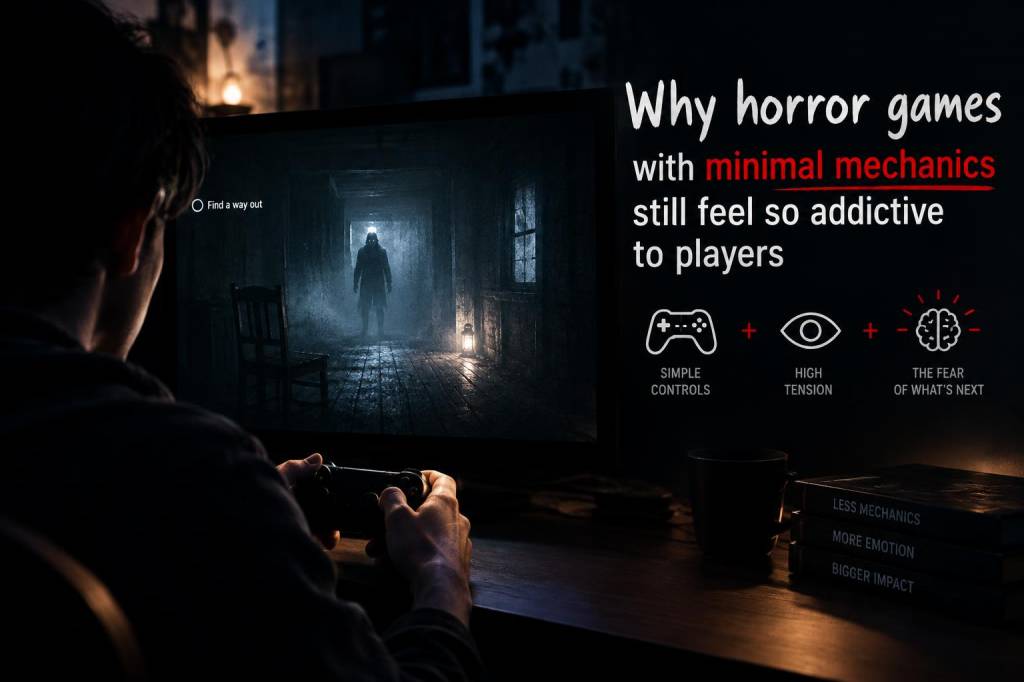
I keep coming back to horror games with very few mechanics because they do something many big-budget experiences struggle to do: they get under my skin almost immediately. When a game strips away complex systems, skill trees, and long tutorials, it leaves me with something much more fragile and much more powerful: vulnerability. That is often where the real obsession begins. I do not need a sprawling combat sandbox or a dozen ways to interact with every object in a room. Sometimes I only need a flashlight, a locked door, a sound in another hallway, and a feeling that I am never fully safe.
Why less can feel more intense
When I play a horror game built around minimal mechanics, I notice something interesting right away. My mind stops worrying about mastering systems and starts focusing on survival. That shift matters. In a complex action game, I can often rely on movement options, weapon variety, or layered strategy. In a stripped-down horror experience, I cannot hide behind depth. I have to sit inside uncertainty, and uncertainty is fuel for fear.
Minimal mechanics also force me to pay attention to details I might otherwise ignore. A creaking floorboard becomes meaningful. A shadow at the end of a corridor feels like a decision point. A sound cue can carry more emotional weight than a full cutscene. Because there is less mechanical noise, every small action becomes charged with tension. Even walking from one room to another can feel like a gamble.
I think that is why these games feel so addictive. They are easy to understand at a surface level, but hard to emotionally detach from. My brain says, “There is not much here,” yet my nerves say, “Stay alert.” That contradiction keeps me engaged.
The pull of constant vulnerability
One reason I keep returning to these games is that they make me feel exposed in a way that many other genres do not. I am not talking about difficulty alone. I mean emotional exposure. When a game gives me only a few tools, each one feels precious. If I have one key, one battery pack, one hiding spot, or one last chance to run, I start treating every choice with serious weight.
That is a powerful design trick. Scarcity creates attachment. If I know resources are limited, I become more invested in every decision. I think about whether I should open a door now or save it for later. I wonder whether making noise will attract danger. I start reading the environment as if it is speaking to me. In horror, that sense of dependency is addictive because it makes me feel responsible for my own survival.
There is also a strange comfort in that vulnerability. I know I am not in control, and that honesty can be refreshing. Instead of pretending I am powerful, the game admits I am fragile. Once I accept that, every small victory feels earned. Reaching a save point, escaping a chase, or surviving a long stretch of silence becomes deeply satisfying.
Fear works better when I fill in the blanks
My imagination does a lot of work in horror games with minimal mechanics. When a game does not constantly explain everything, my mind starts building possibilities. That is often scarier than any direct threat. If a hallway is too quiet, I assume something is waiting. If a room is empty, I suspect it will not stay empty for long. If an enemy is only seen briefly, I remember that image far longer than I would remember a detailed combat encounter.
This is where minimal design becomes clever. It leaves room for dread to grow inside me. Instead of showing everything, it suggests enough to let my brain complete the picture. I end up scaring myself more effectively than any scripted moment could. That level of personal participation is one reason these games stay with me after I stop playing.
I also think the absence of mechanics can make a horror game feel more intimate. I am not managing a busy interface or juggling too many systems. I am alone with the atmosphere. That simplicity lets the sound design, pacing, and visual language do more emotional work. A game like Amnesia: The Dark Descent understands this very well. So does Outlast, where motion, darkness, and pursuit become enough to keep my pulse up without asking me to learn complicated systems.
Simple rules create strong habits
Another reason these games feel addictive is that they train me quickly. Minimal mechanics are easy to learn, which means I can reach the core tension almost immediately. I do not spend hours figuring out a control scheme. I understand the rule set, then I start focusing on survival loops. That fast access matters because horror works best when I am already immersed in the mood.
Once I understand the loop, I begin developing habits. I listen before opening doors. I crouch near corners. I memorize safe routes. I conserve resources. I check shadows. These habits create a rhythm, and that rhythm becomes part of the fun. Every time I repeat a behavior successfully, I feel a tiny hit of relief. Then the game interrupts that comfort with another scare, and I am pulled right back in.
That cycle of stress and relief is incredibly effective. It keeps me returning to “just one more try” because every attempt feels slightly different. Even when a game is simple, no two runs feel identical once fear starts shaping my choices. I am not only reacting to the game. I am reacting to my own memory of what scared me before.
What minimal mechanics do better than complexity
I do not think minimal mechanics are automatically superior. Some horror games need more systems to support exploration, combat, or puzzle design. But when minimal mechanics are used well, they do several things especially well:
| Design Element | Emotional Effect |
|---|---|
| Limited movement options | Raises panic and makes escape feel uncertain |
| Few usable items | Turns every resource into a meaningful choice |
| Simple objectives | Keeps attention on atmosphere and danger |
| Restricted visibility | Increases imagination and anticipation |
| Low combat depth | Strengthens helplessness and suspense |
That table captures something I feel every time I play one of these games: simplicity is not a weakness if it sharpens emotional focus. When systems are pared back, horror can become cleaner, meaner, and more direct. I am not distracted by upgrades or character builds. I am living inside a threat.
Why repetition does not ruin the experience
Some people assume a simple horror game will become boring fast, but I often find the opposite. Repetition can make the fear stronger. Once I know the basic rules, my brain starts anticipating danger before it arrives. That anticipation creates tension even in quiet moments. I know something may happen, but I do not know when. That delay is part of the hook.
Repetition also gives me a chance to improve without making me feel powerful. I become more skilled at navigating fear, not at defeating it. That distinction matters. In a horror game with minimal mechanics, mastery often means I panic a little less, notice details sooner, and make fewer reckless decisions. I am still vulnerable, but now I am vulnerable with awareness. That is an engaging emotional state because it feels earned.
I have noticed that games like Slender: The Eight Pages and Five Nights at Freddy’s use this very well. Their systems are easy to grasp, yet each session creates a different emotional pattern. I know what I am supposed to do, but fear keeps reshaping my execution. That keeps me playing far longer than I might expect.
Sound, pacing, and silence do heavy lifting
When a horror game does not rely on complex mechanics, every other element has to work harder. Sound becomes crucial. Silence becomes a threat. Pacing becomes a weapon. I can feel a game leaning into me through a distant hiss, a footstep above me, or a sudden drop in ambient noise. Those details stay with me because they are not competing with a dozen gameplay systems.
I often find that the most addictive minimal horror experiences understand restraint. They do not overwhelm me with nonstop action. They let tension breathe. They allow a room to sit in silence long enough for my mind to start inventing danger. Then, when something finally happens, it lands harder. That rhythm keeps me invested because I am always waiting for the next shift.
Even the act of moving through space can become part of the appeal. Slow corridors, narrow rooms, and limited visibility turn ordinary navigation into emotional labor. I am not simply advancing through a level. I am enduring it. That subtle difference is part of why these games feel so memorable.
Why I keep chasing that feeling
I think I keep playing horror games with minimal mechanics because they deliver a very specific kind of emotional honesty. They do not pretend I am in control. They do not hide fear behind busy systems. They place me in a fragile position and ask me to stay there. That is uncomfortable, but it is also thrilling.
There is something deeply satisfying about a game that can make my hands tense up with almost nothing more than a hallway, a light source, and a sound I cannot place. That is not a failure of design. It is a sign that the design is focused. It understands that horror is often strongest when it is felt, not explained.
And honestly, that is why I keep coming back. These games are easy to enter, hard to forget, and emotionally louder than their mechanics suggest. Every quiet corridor, every limited tool, and every moment of helplessness keeps me alert in a way few other genres can match. Even when I know exactly what kind of experience I am stepping into, I still want one more round, one more scare, one more chance to face that same fragile feeling again.