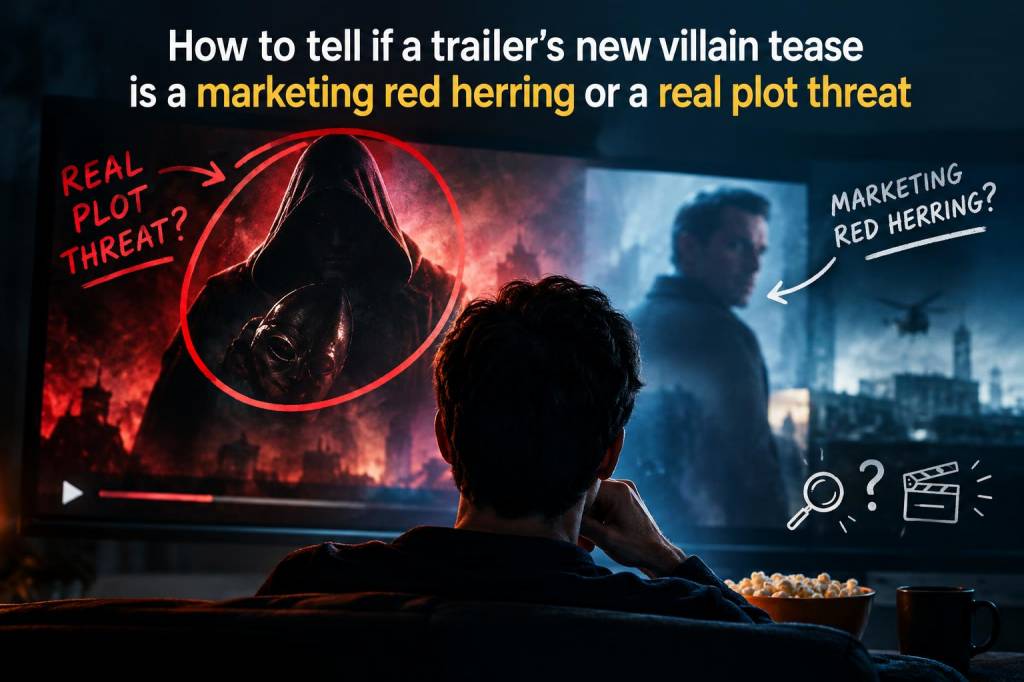
I still remember the first time a trailer convinced me a new character was going to be the franchise's next big villain — only for that character to flicker across the movie for a single scene and disappear. Since then I've made it a small hobby to interrogate trailers the way a detective reads a ransom note: every cut, every close-up, every musical sting feels like potential evidence. Over the years covering premieres and sitting through countless EPKs for Fandomwire Co, I've learned there are telltale signs that separate genuine narrative threats from marketing red herrings designed to get people talking.
Understand what trailers are actually selling
Trailers are sales tools first and narrative devices second. Studios want eyeballs, tweets, and headlines. That means trailers often prioritize spectacle, mystery, and emotional beats over laying out an honest map of the plot. If something in a trailer is outrageously intriguing yet lacks clear context, treat it like bait. Marketing teams lean into ambiguity because it encourages discussion and online theorizing — which is free publicity.
Look at screen time and focus
A good first checkpoint is how much presence the “new villain” actually has in the trailer. If the character gets several distinct beats — a monologue, a close-up with purposeful framing, and an escalation of stakes — they’re more likely to be integral to the plot. But if the trailer shows just one striking image, or the villain is repeatedly shot from distance or behind an obscuring object, that can be a sign of misdirection.
For example, I’ve seen trailers where a masked figure is shown only in silhouette across three separate cuts — visually cool, but narratively vague. That silhouette might be a cinematic tease, not a story anchor.
Check how the protagonist reacts
One of the most reliable signals is the protagonist’s response. If the hero’s emotional arc in the trailer revolves around knowledge of or conflict with the new antagonist, the threat is more likely to be legitimate. Conversely, if the protagonist appears unaffected or their scenes are intercut with the villain in a way that doesn’t suggest confrontation, the villain may exist primarily to spice up the trailer.
Pay attention to editing and sound design
Sound is an underrated clue. Non-diegetic music cues, echoing phrases, and punctuation stings can be added after the fact to manufacture menace. If a villainous line is backed by a sudden drop to silence or a heavy bass hit, that’s classic trailer dramaturgy. Meanwhile, diegetic audio — a character speaking within a scene or a consistent motif tied to on-screen action — is harder to fake and often indicates actual narrative material.
Notice where the villain appears in the trailer structure
Trailers often follow a three-act arc: set-up, escalation, payoff. Where is the villain placed within this structure? If they appear in the set-up and are woven into scenes that establish stakes, that's a strong sign they're central. If they only show up in the final payoff as a shock image, consider it deliberate sting bait.
Examine the costume and practical details
Marketing departments sometimes create unique visual breadcrumbs for trailers — clothing, props, or makeup that look more stylized than lived-in. If a villain’s look reads like a concept render or an Instagram-ready costume rather than a piece of a coherent world, it may be designed primarily for promotional impact. On the other hand, small practical details — scuffed leather, realistic prosthetics, or props that appear repeatedly across different moments — suggest significant screen time and story integration.
Look for casting and credit clues
Who’s playing the villain? Big-name actors getting top billing are less likely to be mere cameos (though stunt cameos happen). But watch out for tricky crediting: sometimes a well-known actor will be billed in surprise ways to keep spoilers in check. Also, check press releases and casting announcements. If a character is given depth in promotional interviews or the actor discusses long-term involvement, that usually signals a real plot role.
Merchandise and tie-ins are revealing
Merch can be an honest-to-God canary. If the studio is investing in action figures, Funko Pops, or official posters featuring the new villain, they're often betting on that character sticking around in ways that justify the expense. Conversely, if all you see is hero merch and the villain’s presence is limited to a teaser poster, the character might be a marketing flourish.
Read the press cycle and interviews
Directors, writers, and producers sometimes accidentally give away more than intended in interviews. If a director talks about the villain in depth — their motivations, backstory, or relationships to the protagonist — that’s credible evidence. Conversely, evasive PR language like “we wanted to surprise audiences” is often a polite way of admitting the reveal is manufactured. I always cross-reference what the creatives say with what the trailer shows.
Consider narrative economy and genre conventions
Stories have constraints. If the trailer implies elaborate new mythology without showing how it connects to the protagonist's goals, ask whether the script can realistically accommodate that. In tight, character-driven dramas, every new figure must serve a purpose. In blockbuster franchises, there’s more room for spectacle and detours. My rule of thumb: the more intimate the film, the higher the chance the trailer’s villain is real if they get significant focus.
Watch for meta red herrings and franchise habits
Some filmmakers and studios have a history of planting red herrings. J.J. Abrams popularized the “mystery box” approach, and many marketing teams inherited the habit of teasing unknowns that never fully materialize. If a franchise has historically used misdirection (or if the director is known for surprises), take trailer teases with a grain of salt.
Use community signals — but verify
Fandom chatter, leaks, and early screenings can provide powerful clues. I monitor social channels and attend fan events where early impressions often surface. But social proof is fallible: viral speculation can amplify small details into supposed proof. Treat fan claims as leads, not verdicts, and look for corroborating materials like stills, script excerpts, or accredited journalist reports before updating your belief.
Simple checklist to weigh a trailer tease
| Signal | Indicates real threat | Indicates red herring |
|---|---|---|
| Multiple focused beats | Yes | No |
| Obscured/one-shot appearance | No | Yes |
| Strong protagonist reaction | Yes | No |
| Heavy non-diegetic audio cues | Sometimes | Often |
| Merch or tie-ins | Yes | No |
| Director/actor confirmations | Yes | Vague PR language |
I try to keep a skeptical but generous eye: trailers can mislead, but they also sometimes give fair glimpses into a story you’ll actually experience in the theater. When I watch a new trailer, I balance excitement with a checklist like the one above, and I let the film itself be the final arbiter. In the meantime, arguing with friends about whether that eerie masked figure will turn out to be an ambiguous ally or the villain who ruins everything is half the fun of being a fan — and that, ultimately, is exactly what marketing teams are counting on.