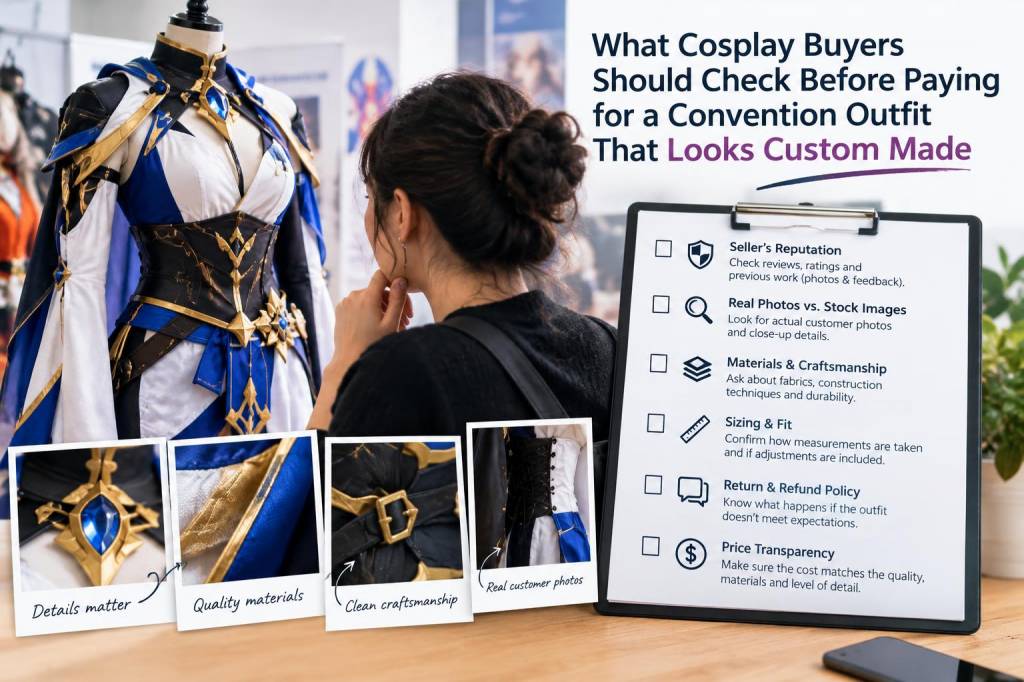
When I shop for a cosplay outfit that is supposed to look custom made, I start with one simple assumption: a polished photo is never enough. I have seen too many listings that look flawless at a glance and then fall apart once I zoom in, read the fine print, or ask a few direct questions. If I am spending serious money on a convention outfit, I want proof that what I am buying is carefully built, accurately described, and actually wearable for a full event day.
What I check first is whether I am looking at a finished costume, a made-to-order piece, or just a sample image. Those are not the same thing, even when sellers present them as if they are. A finished costume should match the photos closely, while a made-to-order piece should still come with clear expectations about sizing, fabric changes, trim placement, or hand-made variation. A sample image, on the other hand, may only represent the style. If a seller cannot tell me exactly which one they are offering, I pause immediately.
I also look for signs that the seller understands the character and the source material. Custom cosplay is not only about sewing skill. It is about accuracy, shape language, color matching, and details that fans will notice instantly. If the outfit is for a character with a very specific silhouette, I want to see whether the seller has replicated that structure with care. If they say “inspired by” rather than “screen accurate,” that is not automatically a problem, but I want that distinction made clear before I pay.
Photo evidence I trust before paying
One of my strongest habits is asking for more than one kind of image. A single glamour shot can hide a lot. I want front, back, side, and close-up views. I want to see stitching, seams, closures, lining, and any printed surfaces from a short distance and up close. If the costume includes armor pieces, I want a clear look at attachment points and edge finishing. If it includes embroidery or appliqué, I want enough detail to judge whether it is clean work or a printed shortcut.
I also pay attention to whether the seller uses the same photos repeatedly across different listings. That can be normal for a small maker, but I still ask where the actual item in the photo is. If the seller is making a custom version for me, I want proof of past work that looks consistent. Consistency tells me more than marketing language ever will.
- Front, back, and side photos
- Close-ups of seams, hems, and closures
- Images of texture, fabric weight, and lining
- Photos of real clients or prior commissions
- Clear labeling of what is included and what is not
Fabric, structure, and comfort matter as much as appearance
A costume can look custom made in a photo and still be miserable to wear. I check fabric content whenever possible because it affects comfort, movement, heat, and durability. A convention outfit made from a stiff synthetic fabric may hold shape well, but if I will be wearing it for ten hours under bright lights, I need to know whether it breathes or traps heat. Likewise, a delicate fabric might look beautiful but snag easily in a crowded hall.
Structure is another detail I never ignore. A coat, bodice, or jacket can look expensive from the outside while relying on weak internal support. I ask whether the piece has interfacing, boning, shoulder structure, hidden zippers, elastic panels, or reinforced stress points. If the seller cannot explain the internal construction in plain language, I assume the outfit may look better than it performs.
Comfort matters because convention days are long. I want to know where the fabric stretches, where the closure sits, whether sleeves restrict motion, and whether the neck, waist, or boots will cause pain after a few hours. A costume that looks incredible for fifteen minutes but becomes unbearable by lunchtime is not a good buy for me.
Measurements, sizing, and fit need real conversation
Custom-made should mean more than “available in several sizes.” I always check whether the seller asks for actual body measurements rather than only standard sizes. If they only request small, medium, or large, I become cautious. True custom work usually depends on shoulder width, bust, waist, hip, inseam, sleeve length, and sometimes height or torso length. For cosplay, those details matter because character proportions often differ from everyday clothing.
I also ask how the seller handles fit adjustments. Is there room for alterations if the costume arrives slightly off? Are there seam allowances built in? Can the seller make the garment with a looser or tighter fit in certain areas? If I am investing in a made-to-measure outfit, I want to know whether the final piece will reflect my body and not just a generic size chart.
Another thing I check is whether the seller provides a measurement guide. A serious maker usually explains exactly where each measurement should be taken. If that guide is vague, I consider that a warning sign. I do not want to discover later that a “custom fit” was based on guesses.
| Check | What I want to see | Why it matters |
|---|---|---|
| Photo proof | Multiple angles and close-up detail | Shows real construction quality |
| Fabric data | Content, weight, stretch, and lining | Helps judge comfort and durability |
| Measurement process | Specific measurement instructions | Reduces fit mistakes |
| Revision policy | Clear alteration or remake terms | Protects the buyer if something is off |
| Delivery timeline | Production time plus shipping buffer | Prevents convention-day panic |
Closures, accessories, and hidden extras can change everything
What looks like a finished outfit in a listing may actually be incomplete. I always check whether belts, gloves, props, wigs, shoes, petticoats, or underlayers are included. Some sellers photograph a full styled look but only sell one garment. Others include accessories in the photo but not in the package. I have learned to read descriptions like a contract. If it is not listed, I do not assume it is part of the deal.
Closures deserve special attention. I want to know whether the costume uses a zipper, lacing, hooks, snaps, magnets, or Velcro. Each one affects appearance, speed of dressing, and long-term durability. Hidden zippers may preserve a clean silhouette, but they can also fail if they are cheap or poorly installed. Lacing allows more sizing flexibility, but it may need help from another person to put on. These details sound small until I am trying to get ready in a hotel room with fifteen minutes to spare.
If the costume includes armor, foam, thermoplastic, or resin parts, I ask how they attach and whether they are safe to transport. Heavy accessories can crack in transit, and sharp edges can ruin both comfort and appearance. I want to know if they are sealed, painted, and reinforced or if they are mostly decorative.
Seller communication tells me a lot about the final product
I judge a cosplay seller by the way they answer questions. A good maker does not need to be perfect, but they should be specific, patient, and consistent. When I ask about stitch type, fabric source, time frame, or fit, I want direct answers. If I receive vague replies, copied text, or pressure to pay quickly, I slow down. Custom work requires clear communication, and a seller who cannot communicate well before the sale is unlikely to improve after payment.
I also like to ask for process photos if the seller offers commissions. Progress shots can reveal whether the piece is being built carefully or assembled in a rush. They also help me catch problems early, before the outfit is fully finished. If a seller refuses any form of progress update, that is not always a dealbreaker, but it does make me more cautious.
Another thing I watch for is whether the seller welcomes revision requests. A custom cosplay should feel collaborative. I want to know whether I can request changes to trim placement, sleeve length, hem length, or color balance before the final ship-out. If revisions are treated like a burden, that does not inspire confidence.
Price, timing, and return terms should never stay vague
If a costume looks custom made, I expect the price to reflect labor, materials, and skill. But high price alone does not guarantee quality. I compare the price against the photos, the amount of handwork, and the complexity of the design. A simple outfit sold at a luxury price needs stronger justification than an intricate, layered costume with visible craftsmanship.
Timing matters just as much. Convention season can create rushed orders, and rushed orders often lead to mistakes. I check production time, shipping method, customs delays if applicable, and whether there is a backup plan if the seller misses the deadline. If I need the costume for a specific event, I build in extra time. A pretty outfit arriving after the convention is not useful to me.
I also read return and refund terms before I pay. Many custom pieces cannot be returned once production begins, which is fair if the policy is clear. What I do not accept is a seller hiding behind a no-return rule while giving no proof of quality or fit. I want to know what happens if the item arrives damaged, incomplete, or significantly different from the listing.
Little details that help me avoid disappointment
Over time, I have built a mental checklist that saves me from expensive mistakes. I never ignore the background of the photos, because a cluttered or inconsistent background can hide fabric flaws. I never ignore the lighting, because strong filters can make colors look richer than they really are. I never ignore reviews, especially if they mention fit accuracy, communication speed, or whether the final item matched the preview images.
I also look for signs of hand-finishing. Clean hems, matched pattern placement, neat interior seams, and balanced embellishment placement all tell me that the seller has taken time with the piece. A costume can still be wonderful if it is not perfect, but I want to see intention. That is what makes something feel custom made rather than mass assembled.
- Check whether colors look consistent across all photos
- Ask if fabric dyes may vary from the images
- Confirm whether props or shoes are included
- Read all size notes instead of trusting one chart
- Look for stitching quality, not only surface shine
- Verify shipping timeline before placing the order
- Save screenshots of the listing and all messages
When I buy a convention outfit that is meant to look custom made, I am really buying trust. I want proof, clarity, and enough detail to picture exactly what will arrive at my door. The more a seller can show me before payment, the more confident I feel wearing that costume in front of other fans, photographers, and strangers who know the character just as well as I do.